CMV Negative!

Today at Maggie’s clinic visit we got the news that she is CMV Negative. This very likely means that her adaptive immune system is now back online and clearing viruses. Full celebration pending official count of CD4 cells.

Here’s my mental model of why I’m so excited.

Before Maggie even started her pre-transplant work-up, more than 4 months ago, she was a known carrier for CMV (a very common, usually non-noteworthy virus). During the transplant process, the immune system is almost entirely eliminated. Unsurprisingly, with nothing on board to fight bugs, the CMV reactivated, and she became viremic (active virus detectable in the body) for CMV. To keep the virus at bay, anti-viral medications were used in lieu of the normal immune system. This mostly worked to keep her stable, but the viremia persisted. Anti-viral drugs can’t fully eliminate CMV, so it hangs around persistently.

Fighting a virus such as CMV is one of the most complicated things that the immune system does. It requires a type of cell called a CD4, T-cell, which is a type of lymphocyte, which is a type of white blood cell. Those are the cells that go to the thalamus, and get trained to look for foreign viruses and run around killing them. This is a component of what’s known as the adaptive immune system.

The fact that she is now CMV negative, meaning no detectable virus, suggests that she has active, working CD4 cells. Phew, long explanation. Anyway, I’m happy about it.

Freedom!

Maggie was discharged from the hospital today, and it was a great day. Everyone got to go outside, and all three girls hung out with mommy, Gammy, and Baba. Great Sunday 🙂

Tracy edit for the medical update: Maggie’s pericardial drain pretty abruptly stopped putting out fluid and an echo confirmed there is minimal fluid left around her heart, so we are cautiously optimistic maybe we can avoid a pericardial window/surgery. But she has a repeat echo scheduled for Wednesday and if the fluid reaccumulates, she’ll go to surgery. But we get to stay at RMH in the meantime!

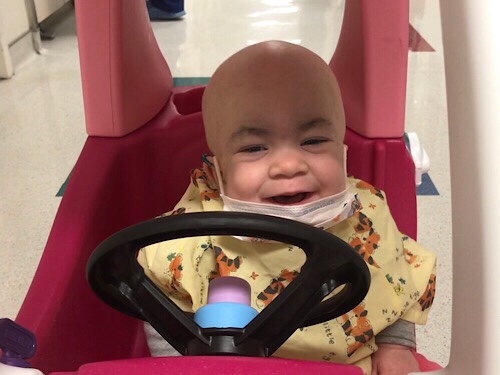
Driving in my car

Well, day three back in the unit and Maggie’s pericardial effusion is back. They drained 50cc the first day, 5cc, yesterday, and 70cc today. Tracy thinks the draw yesterday was stopped prematurely because of a kink in the drain line, so we don’t have good data on the rate of fluid buildup other than at least 70cc every two days.

The effusion fluid appeared redder today, but we tested it and it had a hematocrit of only 2. (Compared to Maggie’s blood which has a hematocrit of ~29). Meaning, the fluid was <10% blood. Whatever the fluid is, it continues to be produced prodigiously. We’ll wait to see what drains tomorrow. Our hospital stay now has no particular end in sight.

In the mean time: let’s go for a drive!

Family Resemblance?

Here’s Maggie, double fisting chicken nuggets at her clinic visit today. Does this remind you of anyone else in the family? Daddy?

Also, Maggie was readmitted to Duke 5200 today. She has a pericardial effusion, i.e. fluid build up around her heart. Per Maggie’s doctors, this is most likely “immune-mediated” meaning it’s caused by an off-shoot of her new immune system getting confused about all these funny looking heart cells and recruiting fluid to the area to help get rid of the pesky heart. It’s a lot like puss surrounding a splinter, except it’s on a larger scale.

The next step is to mechanically drain the fluid using a tube, which is a surgical procedure. Also, since fluid will continue to develop, the tube will be left in so it can be used to drain more fluid periodically. All of this boils down to more time in the hospital on 5200. Out of the ~463 pediatric transplant patients at Duke in recent years, approximately 10% had a pericardial effusion side effect such as this.

The Blue Shark Lymphocyte

Some good (but a little complicated to explain) news on Maggie’s bloodwork yesterday. I’m learning a lot of this as we go, so I’ll share some of that.

Maggie’s white blood cell count went up without drug assistance from 3.2 to 4.3, which is a great number. The threshold for treatment (for Maggie) is 3. So, to start above 3, and then climb way out of the treatment range is a great sign.

Even better is the percentage of white blood cells that are Lymphocytes. Lymphocytes represent the cornerstone of the adaptive immune system and are the cells that would battle off a viral infection. Potential viral infections are one of the main reasons we have Maggie quarantined from other people.

The percentage of Maggie’s white cells that were Lymphocytes was 33%. The typical cord blood transplant child that is 62 days post-transplant would be about 3%, so she is WAY ahead of the curve here. Great news. She’s also doing this while on a drug called Gancyclovir that has known marrow suppressive side effects. (She’s on Gancyclovir as an anti-viral because she has an active viral infection called CMV).

For the future: One type of lymphocyte is the CD4 T cell. These are the same types of cells that you’ll hear people talk about for patients with AIDS. One of the next major hurdles that we’ll try to cross in the transplant process is a CD4 count above 200. We haven’t even measured her CD4 count yet. That first test will happen somewhere around day 100 post-transplant. When the CD4 count hits 400, that’s when Maggie can safely weather a viral infection.

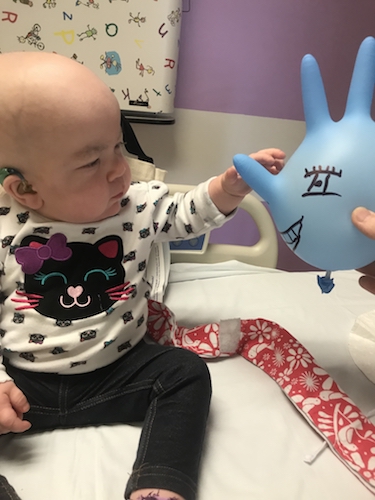
Shown here is Maggie interacting with a 3d model of a blue shark lymphocyte.

Meeting of Titans

Maggie and her new best buddy Mila finally got together for some play time! Here they are playing ball at Ronald McDonald House.

Also, this was the first day that Maggie didn’t have to go to the hospital at all for either lab work or some kind of infusion. A full day off. The day felt strangely long.